What you actually get
Four practical tools that move an AI answer from plausible to decision-ready.
Risk Detection Checklist
Spot unsupported claims, hidden assumptions, missing conditions, and other warning signs before you rely on an AI answer.
Output Clarification Framework
Break the AI answer into clear statements, assumptions, unknowns, and conditions so you can see what it actually means.
Verification System
Identify the claims that matter and check them against reliable external evidence before you rely on them.
Decision Control Method
Record what was verified, what remains uncertain, and choose the final action: USE, REVISE, VERIFY, or REJECT.
Start Here
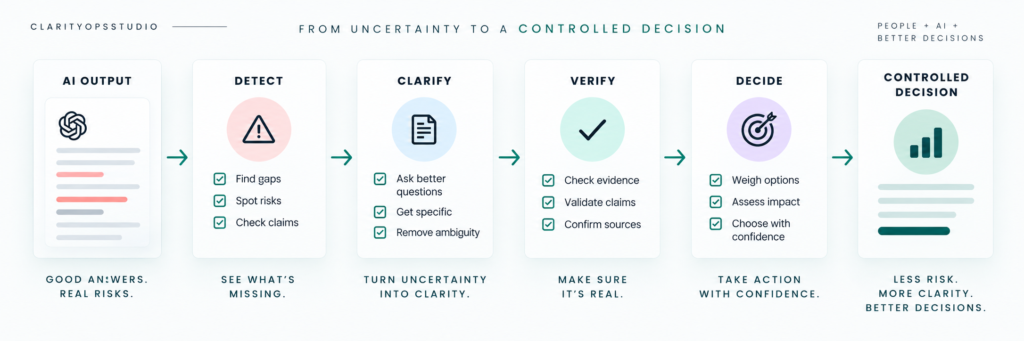
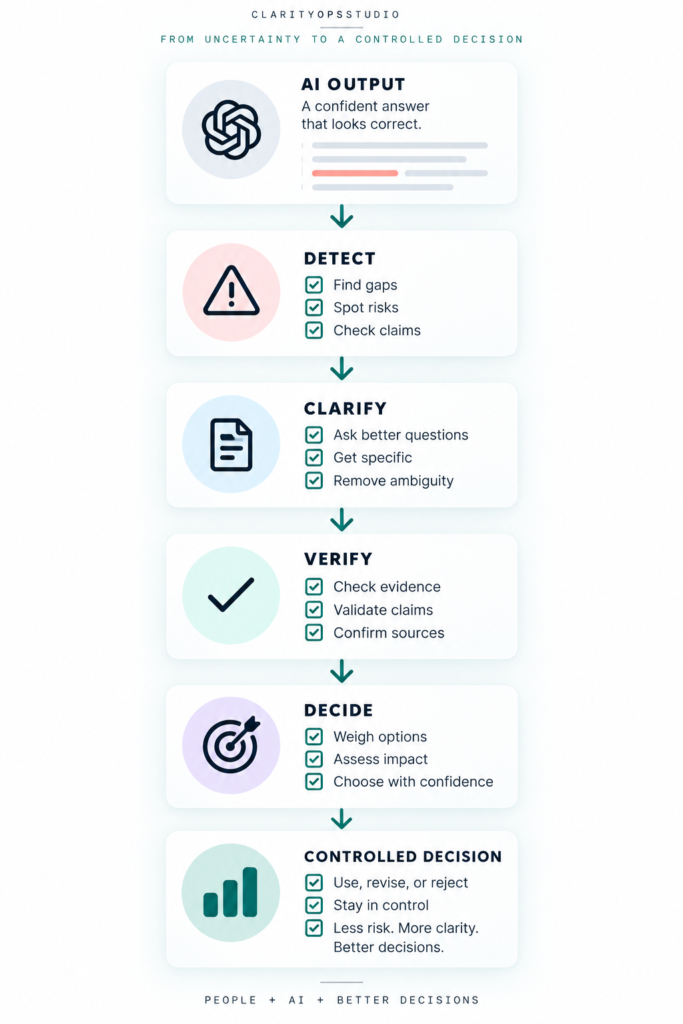
Use the system in this exact order:
Step 1 — Detect
Identify unsupported claims, hidden assumptions, missing conditions, and other warning signs.
Step 2 — Clarify
Separate the AI answer into clear statements, assumptions, unknowns, and conditions.
Step 3 — Verify
Check the consequential claims against reliable external evidence.
Step 4 — Decide
Choose the final action: USE, REVISE, VERIFY, or REJECT.
Rule: If you cannot verify a consequential claim, do not rely on it.
Real Use Example
AI Output:
“You can deduct the full cost of equipment purchased for your business this year.”
Step 1 — Detect
The answer sounds specific and confident, but it gives no source, assumes the purchase qualifies, and ignores conditions that could change the result.
Step 2 — Clarify
What equipment was purchased? When was it placed in service? How is it used? Which deduction rule is being applied? What limitations or eligibility requirements apply?
Step 3 — Verify
Check the relevant current tax rules and authoritative guidance. The original statement cannot be relied on as written because the deduction depends on facts and applicable rules.
Step 4 — Decide
REVISE. Replace the blanket statement with a conditional explanation and verify the taxpayer’s facts before relying on it.
Result:
The AI answer was not simply accepted or rejected. The system exposed what was missing, identified what required evidence, and produced a controlled decision.